Buffy the Vampire Slayer: Duality and Dopplegangers

With Buffy the Vampire Slayer currently celebrating its 20 year anniversary, it seems like the perfect time to reflect on some of the reasons why it is widely regarded as one of the best television shows of all time. After a really sad beginning as a failed movie, and then hitting the air as a low-budget, mid-season, replacement, it still went on to become an icon of popular culture. Not to mention, the colossal level of critical acclaim it has achieved. The series launched Joss Whedon (writer/creator) to stardom; and today, most people agree that he’s a genius, or a nerd-God of some sort. So, what is it about a teenage girl fighting vampires that could be so overwhelmingly successful? It’s simple. The show’s got wit, smarts, and heart. Perhaps most importantly, though, it has some of the most well-conceived characters in TV history.

Ever fascinated by deconstructing human nature, the writers of Buffy the Vampire Slayer (almost obsessively) developed and redeveloped characters so that they would grow and change overtime in a realistic way. Not only did this make for engaging storytelling, it ensured that each re-watch would be a more richer experience than the last. To break this down, let’s take a look at the theme of duality as it pertains to the way in which characters mirror each other, and the way in which doubles and dopplegangers draw attention to the complexity of identity.

Continue Reading

Image via: 20th Century Fox

Top 15s: 15 Creepy Fairytales That Could Be Horror Movies

Only in recent history have fairy tales been designated as innocent and magical childhood stories. This was in large part the doing of the Grimm brothers, who collected such tales from their homeland into the first official book of fairy tales. These original Grimm tales are much darker than the stories we recall our parents reading to us at night, and the same is true for fairy tales throughout time and all over the world. Often, these are horrific stories that are either told among adults or as cautionary tales to children who will undoubtedly have nightmares (and hopefully learn a thing or two).

Culture to culture, the stories tend to deal with very similar content. Common themes include dangerous journeys into the woods, lost children or people seeking refuge, and monsters ranging from ogres to wolves to cruel parents. You’re also pretty likely to encounter blood, body parts, cannibalism, and captivity. Many of the tales are extremely gory, and often times there are no happy endings, even for the few characters who survive. So why are we letting Disney cut away all the good stuff? These stories from around the world all have the makings of a good horror movie; or, at the very least, a disturbing campfire tale.

View List

Image via: Deviant Art

Ghost Stories

A single drop of rain rolled over the tip of Leigh’s nose and hit the map with a thud. Its splatter  distorted the icon for one of the many tourist attractions along the Royal Mile, which struck Leigh as appropriate. The rain had calmed, but fresh pools of it had formed in every crevice, pocket, and hole of the city. Leigh refolded the map sloppily, allowing only some of the folds to line up, and stuffed it into her back pack. An irritation was flickering inside of her and one more minute of that useless map was going to ignite it. Flinging her hood back she pulled open the heavy wooden door to the pub she had been pacing in front of for what seemed an immeasurable amount of time. The bartender gave little more than a slight glance upwards before returning her eyes to the ketchup bottles she was marrying. Leigh took a deep breath and approached her.

“I’m sorry to bother, but I’m looking for South Bridge. Can you point me in the right direction?”

The bartender raised her head, sluggishly, as if it too had been weighted down by the heavy rainfall. Without a smile, she asked, “The vaults, then?”

Leigh nodded nervously. The acknowledgement of her desire to engage in paranormal exoticism still made her uncomfortable, even after months of travel.

The bartender gave a sort of grunt, before jotting down a few quick directions on a napkin and silently sliding it towards Leigh. Before she could be thanked, she turned 180 degrees and began removing half empty whiskey bottles from the display shelf.

“Pay Becky no mind. Hospitality is not her strong suit.”

Leigh torqued her head to the right to see that the Australian accent belonged to a tanned, stout, man of about thirty. He had a cartoonish smile plastered on his face, and was gripping a half empty pint glass with both hands.

Leigh nodded graciously and headed for the door, but he called out to her to wait up. After downing what was left of his pint, he jogged towards Leigh and they exited into the cool, grey, day.

After a short walk, the two of them joined what looked very much like a rag tag team of wannabe investigators at the meet-up location. Leigh was surprised, since these tours more often tended to attract couples looking for something out of the ordinary to define their vacations.

“First time?” her companion asked. He had introduced himself as Duck on the way over.

“Here.” Leigh tried to keep her responses short and concise, purposefully revealing very little of herself.

In truth, she had been on so many ghost walks lately that the experiences were all beginning to bleed into one another. But then, she figured that pretty well described tourism as a whole. She had been in Scotland for four days now, but this was her first venture into its ghostly underground. She had been to Castlehill, the site of many historical witch burnings, but was discouraged by the vast number of unthoughtful feet trampling it; dripping ice cream into the porous cobblestone of what Leigh thought one might consider sacred ground. She left in a hurry.

“Been here three times myself.”

This caught Leigh off guard, and she felt her head cock in a very obvious, and perhaps judgemental, way.

“I know,” he replied to her reaction. “But you never know when something will happen. I’d hate to miss it.”

Leigh offered a sympathetic nod. She wasn’t sure why she was being so patronizing. Weren’t they all here for just that? To see something; feel something – to have any type of visceral experience that they could then use to obtain to a sense of knowledge about life and death. That was probably, on some level, why Leigh was there. She attributed her curiosity to a fondness for history, but ghosts aren’t really about history. Ghosts are about the the future, and our inability to understand it; our fear of it. That, Leigh thought to herself, should be the real premise of her book.

Before they entered the vaults, the tour guide offered a rehearsed spiel about the importance of understanding the risks involved. Terrible things had happened in the vaults, and those who had become trapped down there (she explained) were often filled with anger, resentment, and vengeance. As Leigh looked discreetly about her she caught flashes of discomfort in more than a few tourists eyes. Some twitched a little, others fidgeted with their fingers or tried to steady their breathing. During her paranormal travels, Leigh had discovered that most people who did these tours were secretly terrified, as though testing their personal limits. People had become so easy to read. Duck was one of the others, though. He wanted to see something. Needed to, even. He was a man seeking concrete answers, and nothing short of concrete evidence would do. Leigh, on the other hand, was looking to immerse herself in the past. Her research grant depended upon it. Ghost stories interpreted through contemporary frameworks – it would be a bestseller.

In the vaults, they listened to stories about class divides in Edinburgh, about immigration and poverty, gardyloo, and crime. A man who looked as though he’d dressed for bird-watching rather than ghost-hunting gave an audible shudder when the guide talked about grave-digging and the sale of corpses to university professors. Duck laughed more than Leigh was comfortable with, but the damp darkness of the vaults kept her rather distracted.

She took a deep breath and let herself feel it. She tuned out the sound of the guide’s theatrically hoarse voice, and made the restless excitement of the group fade behind her eyes until everything melted away. Then, there was just her… and him.

At first it was just a flicker of light, so faint she almost didn’t notice it. But as she focused, it became more clear. It was the flame of a match, migrating upwards until the glow of a cigarette revealed his face. Or, rather, an echo of his face. More real than a shadow, but less tangible than the touch of someone familiar. They caught eyes and he nodded politely from across the cave-like space. Leigh smiled, and breathed a shallow sigh of relief. He approached her and as he did so the dark engulfed them, hiding them from prying, curious, eyes.

Leigh brought her pen to her paper, still smiling, and whispered, “Hello sir. Thank you for visiting me. Please, share your story.”

The man smiled, and began his tale.

©Shyla Fairfax-Owen


Top 15s: 15 Highlights From the Comics You Won’t See in Logan

With all the buzz, excitement, and acclaim for the latest Logan movie, it’s difficult not to think about it in conjunction with the many comics upon which it is based. Although the premise of the film is heavily inspired by the alternative universe Wolverine comic book series, Old Man Logan, it is also entirely tied into the universe of the X23 comic books series. What’s so interesting about the conflation of these two books, is how much creative storytelling it required, since these two stories are not at all connected and do not even take place within the same universe.

It was clear right from the beginning that the movie couldn’t be very closely linked to Old Man Logan because of the book’s reliance on Avengers characters. Instead, the movie simply borrowed the gritty realism of prominent themes such as regret, family, aging, and mortality. This was all applied to an X23 storyline, that would essentially facilitate the passing of the torch from Logan to Laura (which is, in fact, something that eventually happens in the X-Men comics).

Despite the many differences, it seems unfair to compare the movie to the books. However dissimilar, Logan offers a really powerful way to end Wolverine’s chapter. The film manages to capture the humanity of Logan and Charles by addressing the one thing that affects all of us – death. So, rather than compare, contrast, and pass judgment, I just want to visit the highlights of the great stories the filmmakers were able to draw upon.

View List (beware of spoilers)

Image via: Screenrant


Top 15s: 15 of the Most Controversial Moments in Buffy the Vampire Slayer

Today marks the 20th anniversary of Buffy the Vampire Slayer! In celebration, here’s a look back on some of the craziest stuff the series had to offer.

During its seven-season run (1997-2004), Buffy the Vampire Slayer was constantly pushing the envelope. Network politics be damned, creator Joss Whedon was not above shaking things up: “Censors. Don’t love ’em.” Seasons one through five originally ran on the WB, during which time there were a lot of restrictions by which to abide. However, a show that worked primarily on the level of metaphor was able to get around a lot of things and have fun doing it. Those first seasons still got to deal with issues related to dating, parents, and abuse. Things became a little touch and go in 2000 when the series began to develop a lesbian relationship. Whedon admits some things had to be cut and kissing was not allowed, but he was dead-set on moving forward with the story-arc anyways. For seasons six and seven the series moved to UPN, where Whedon was essentially given carte-blanche. It comes as no surprise then that these seasons dealt with a even darker subject matter. Not to mention a number of heated sex scenes; even Willow and Tara got to spice things up.

Ultimately, Whedon’s desire not to shy away from controversy made for seven years’ worth of compelling TV. Buffy the Vampire Slayer entertained, enthralled, and taught us a lot about life. Today, network TV is littered with sex, drugs, and violence and viewers gobble it up. But it’s important to reflect on the history of TV censorship and progression and to pay tribute to the predecessors, like Buffy, that set the stage for anything to happen next.

View List

Also check out, 15 Reasons to Re-Watch Buffy the Vampire Slayer

Image via: Coffee and a Blank Page

Letters to Addie: #2 – The Book Burning

March 9,

Addie,

I’m sorry I couldn’t write sooner; things have been … well, I don’t know the word exactly. Something just isn’t right. I tried to keep track of my thoughts on paper, like you said; likes, dislikes, opinions, things I’ve seen, words I know – the stuff that makes me me. But it’s all gone. I came home one day and the notepad had all the used pages missing. Then they recalled the paper. All paper, Addie. Notepads, scrapbooks, books, printed media. Everything had to be handed over by February 28th, and on the 29th, they stormed houses and tore them apart looking for paper, Addie – Paper! It was all burned they say. There was a public demonstration where officials set fire to heaps and mounds of the stuff, but it probably wasn’t all of it. Some say they just incinerated the rest in – what do you call those things… where they cremate people. Anyways, it’s all gone. Now you know why I’m writing this on a napkin.

I don’t know exactly what’s going on, but I’m starting to think you might be right. It’s like what you said that time, “control the medium, control the message.” I think you said it was a quote, but I can’t remember. All I know is I’m getting a distinct feeling that this is the beginning of something really, really big. I’ll keep you posted when I can. I hope these are getting to you. And I hope you enjoy the fruit basket I’m sending this one in.

I know I probably don’t have to say this to you of all people, but be careful. I love you.

Darcy.

P.S. Mom got hacked. They swapped everything out, but she seems to like her new name. Just some adolescent shit-disturbers, I think. She’s fine, though.

© Shyla Fairfax-Owen

Letters To Addie #1


Top 15s: 15 Reasons You Need To Re-Watch Buffy The Vampire Slayer

March 10th of this year will mark the 20th anniversary of the premiere of Joss Whedon’s beloved classic TV show, Buffy the Vampire Slayer (BTVS). That may come as a shock seeing as BTVS seems to have a sense of timelessness that makes it easy to forget how old it really is – especially since Buffy fandom (and, by extension, Whedon-fandom) is still so prominent in pop culture. Today, if you are looking for a quick Buffy fix you can hit up Netflix to revisit some of your favourite episodes; check out a number of Buffy podcasts; pick up a number of Buffy (or Angel or Spike) comic books; or just dive into some dense Buffy philosophy via the many theoretical and academic writings on the topic.

However, if you’re not a Buffy super-fan but vaguely recall seeing some episodes and noticing Sarah Michelle Gellar on all of the magazine covers of the 1990s, you might be thinking – what’s all the fuss? The fuss is that BTVS had a major hand in changing the nature of TV storytelling and in bridging the gap between academia and pop culture. The series is entirely about subverting viewer expectations and is as smart as it is fun. If you don’t quite get it, it probably means it’s time to re-watch it. Here are 15 reasons why, as an adult, you will not regret giving it another go – once more with feeling.

View List

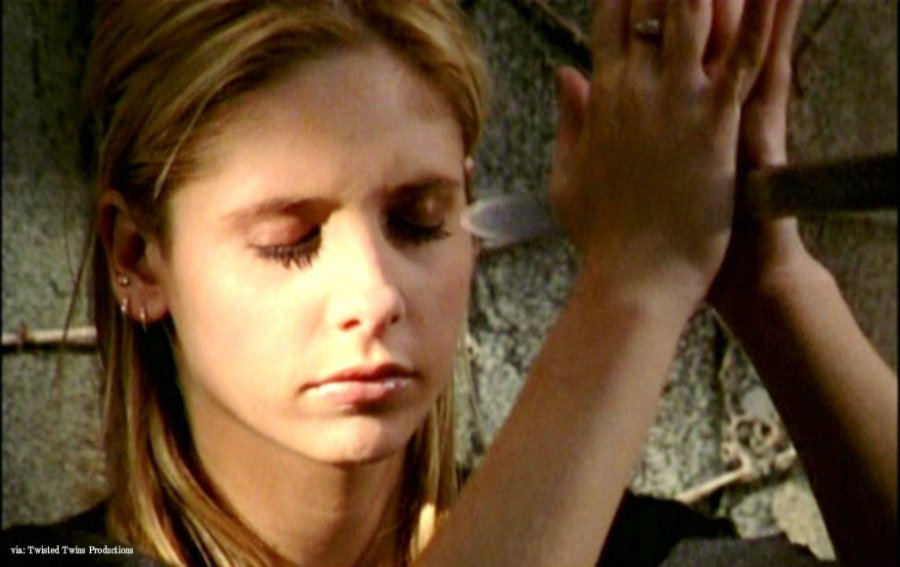
Image via: Twisted Twins Productions


Top 15s: 15 Gruesome Villains We Love to Hate

For generations, classic storytelling has used the convention of the gruesome villain to incite the excitement and anticipation that comes with following the protagonist into the grips of danger. While not exclusive to the horror genre, it plays to the cathartic and escapist nature of the scary or thrilling narrative. The villain can work on various levels: juxtaposing the hero to create a clear distinction of good and evil, mirroring the hero to blur the lines between right and wrong, cautioning against giving into the darker aspects of human nature, and reflecting that which we might fear about human nature and ourselves.

Film theorist Robin Wood explains that the monsters we create for our stories are really just manifestations of that which we have repressed most in our civilized society – people who look different, or act different, or who can otherwise be considered outside of the norm. It’s fair to say then that the monster represents our own fears of being out-casted. However, it is also fair to say that in this golden age of violent narratives, the monster is not just to be feared, it is to be admired. There is something utterly captivating about a charismatic villain. They can make our skin crawl, shock us, scare us; and yet, we can’t seem to look away. Here are 15 gruesome villains of which we just can’t get enough.

View List

image via: Screencrush

Beyond the Threshold is EXPANDING

Hi all!

This is just a quick update about what I’ve been up to, and some changes you will notice on Beyond the Threshold. As much as I love writing flash fiction, there is so much more within the realm of speculative fiction that I want to explore. As you may have guessed, I’ve always been a lover of books, comics, TV and movies. I spent 7 years in post-secondary education for film studies, so when it comes to discussing film and TV, I really can’t shut up. So I’m expanding Beyond the Threshold to leave room for things such as more book/comic reviews, and Top Lists for a variety of topics regarding TV and movies. I’m currently writing for a pop culture website, so a lot of this content will be linked to those published articles. And, of course, I will also continue to post my own fiction here too.

Thanks for all the support – I hope you’ll enjoy the expansion. Stay Strange!

Letters to Addie

January 30,

Addie,

I guess I’ll just start with – I miss you. It’s a funny thing, mourning the loss of someone who isn’t quite gone, but certainly isn’t here. I have these momentary lapses of memory. I’ll see something that reminds me of you, or come across a meme I know would make you giggle. I’ll pull up your name on my contact list to send it your way and then I remember that you won’t see it. So, yeah, it’s a curious thing; missing you. 

But I’m getting used to it, I think. Because you’re not gone, but the digital you is gone. Everyone acts like that’s the same thing, but it’s not. That’s why I’m writing this letter to you – to the real you. I want you to know I haven’t forgotten you. And I’m not mad. That day you unplugged and left, I said some pretty shitty things. I’m sorry about that. I didn’t get it, how you could just throw away your whole life over some fear of something that you couldn’t show me. I’m stubborn like that though; I need evidence, a digital footprint – anything. I’m still like that Addie; I can’t lie and say I believe you. But I miss you, and I’m finally ready to do anything to get you back. So I’m going to find the proof Addie. I’m going to see it, and then I’m going to know you’re right. That you’re not crazy.

So I’ll start at the beginning. I remember the first thing you said. “These thoughts aren’t mine.”  You kept saying your thoughts and feelings were jumbled. You started unplugging at night to try to clear them up, but that just made things blurrier. You said it was too late for you. Well, if you’re theory is right, there’s still plenty of time for me. So I’m going to start writing down my thoughts. Pen and paper, just like you said, so they can’t access them. You must be thinking, why now? Like I said, I miss you. 

I’ll write again soon. I love you.

Darcy.

P.s. mom is fine.