Final Girl Syndrome

I hadn’t pictured it this way. I thought it would be exhilarating, like Texas Chainsaw Massacre 2 when she spins the chainsaw round and round; victorious. Or, maybe even like Halloween, when she just cries and cries.

I guess what I’m saying is, I thought I’d finally feel something. But I don’t. It’s more like Black Christmas; the original or the shitty remake, take your pick.

Just numb. Catatonia, I think it’s called.

His body finally limp; the blood that once filled it splattered across my face and clothes. The nightmare finally over. The chase complete. And he just lies there, and I just stare at him.

He’s taken everyone from me. Everything.

There’s no avenging that.

I’m guessing by tomorrow, I’ll look more like Girl, Interrupted.

How dissatisfying.

Shyla Fairfax-Owen ©

The Way Out

I stood in the middle of the room, gripping the envelope until my fingertips drained of all color. A grave silence filled the surrounding space, from floor to ceiling and wall to wall. It was evening now, and the other household occupants had all headed off to the market to beg and barter for a meal. I had rushed home from work, too eager to put off this moment. And now, finally in it, I felt frozen in time; unable to move forward.

I had been one of the first people to apply for Migration. I did it before the drafting began; there had been more of those than we had expected. As the drafts came in my anticipation built, but the waiting period for applicants was much longer. Many of us had criminal histories and other ‘unsavory’ characteristics, so the Treaty Directors were being extra-thorough. If you were drafted, you had already passed the test.

I set down the envelope to compose myself. For weeks I had been imagining life on another planet; somewhere where I could have freedoms, rights, children. The planet had been being prepped for decades, made to emulate Earth as much as it could. It would be different, there was no doubt about that, but it would be something that we could all recognize. The system was going to be heavily dependent on the social contract, and life was going to be laborious. To me, that meant fulfilling.

And if I had been denied…

I looked at the clock. Josh would be home soon. It would be better to know by then; to practice my expression. If we had made the cut, I’d have to play down my excitement. Josh had always been opposed to leaving. He was convinced it meant giving up on the human race.There were a lot of anti-colonization groups that had been protesting the Migration Project since its conception, but Josh wasn’t like them. The issue was far more superficial for him. He was afraid; afraid to try something so new, so foreign. His white privilege had kept us afloat for a long time down here. We both knew it. Up there, things could be different. We’d both be the Other, and so would our potential children. It didn’t really bother me, though, it was the story of my life.

My mother had been a migrant worker when I was born. She had left Colombia as soon as she found out she was pregnant; afraid that if she put it off we’d be separated, and I’d be killed. At the time, the prospect of colonizing a new planet was real, but the details were still under wraps. Overpopulation was at its worst in Latin America and Asia at that point. North America was catching up, but many people had still been in denial about the inevitability. The American Dream still had a seductive ring to it, and in spite of everything, it still did for a lot of people – but not for me.

My stomach lurched, curling around itself, tugging at my nerves. Snakes. It felt like a hundred snakes wriggling about inside of me, trying to find a comfortable place to coil themselves. But there was no such place. There was just me, and the envelope.

I tore it open on a whim. Quick, like a Band-Aid.

My name, my age, my marital status, my partner’s name…

ACCEPTED.

I stared at the paper. It was real. It even provided a date for us to go in and have our infertility chips removed. It was real.

I read it again, and again.

ACCEPTED.

The door creaked open, snapping me back to life. I blinked, and noticed the tears streaming down my face. Josh entered, lugging a small sack of potatoes from the market. Normally I’d ask what he had bartered, always concerned I’d lose something precious. But not today. Today, I gained something precious.

Josh tried to smile. I tried not to. The silence lingered.

We finally had a way out.

A glint of hope flashed in his eyes.

Our lips met, unsure of what else to do.

Shyla Fairfax-Owen ©

All Hallows’ Eve

‘Twas All Hallows’ Eve, when deep in the house

A creature was stirring, just waiting to pounce,

The stalkings had been happening here and there

In the hopes that the offerings would show they care;

The changelings were nestled all smug in their beds

While visions of skeletons spilled out their heads,

The shadows in the kitchen just waiting to snap

Their victims were fated for a long winter’s nap;

When up in the attic there sounded a clatter

And emerged a monster to make the teeth chatter,

Then through the window glaring eyes glow and flash

Tear open the shutters and come in with a clash;

The full moon scintillates the new-fallen snow

Giving a lustre to the swirling blood-flow,

When what to the following eyes should appear?

But a foolhardy prey upon which they might leer.

Shyla Fairfax-Owen ©

Arctic Apathy

Ana coughed violently as a miasma of blowing snow and fog swirled around her.

“You’re just not used to this climate, yet,” Tucker yelled over the whirring sounds of the harsh environment.

It was true; Ana was not used to the climate. She had only left Calescent a few months ago, and her body still ached for its warmth, its moistness, and its luscious vegetation. Here on Zephyr, everything was a struggle. Her muscles panged all the time, her eyes burned, her skin cracked. Still, she had made a point not to complain aloud, for fear that her guides would question her motives for coming.

As it stood, she had told Tucker and Reese that she was searching for a long lost friend. They may not have believed her entirely, but they were willing to take her through the tundra and up to the mountains for a fair price – or, at least what they considered a fair price. 80 coins. Ana had given them 50, and promised the other 30 upon arrival. She wasn’t good for it, but she’d cross that bridge when she came to it. After all, she was pretty sure she could outsmart the two men, neither of whom seemed particularly quick-witted. If she was misjudging them, she had two knives they hadn’t thought to search her for.

“Should we set up camp soon?” Ana asked, trying not to sound too eager.

Reese looked around at the vastness before them. Ana could not even guess what he would be looking for. There was nothing; nothing, and snow.

“We’ll head north for a while longer and find a cave. We’re too exposed out here. The Feeders will be out tonight.”

Ana thought she saw the shadow of an ominous smirk flash across Reese’s face, but as quickly as it had appeared it had vanished. She shook it off, but patted her breast pocket to feel the assurance of a weapon. The other was hidden deep in her travelling pack.

The trio trudged on in silence, each conserving their breath for when the winds would choke them. By dusk they had found a cave. Tucker and Reese scoped it out, while Ana waited patiently on the outside, keeping guard. She was enjoying playing the role of meek damsel, it suited her. Since she was a child, she had liked to use her femininity to her advantage. It made her difficult to read. Ana liked being difficult to read. It helped her keep her secrets wrapped up tight.

Inside the cave, Ana faced the unpleasant discernment that as happy as she was to be sheltered, she would not be able to sleep next to two men she hardly knew. In an effort to mask her vulnerability with the falsehood of heroism, Ana offered to keep watch against Feeders.

“I’m not much up for sleeping. I’m -” she stumbled, “I’m excited to see my friend.”

The men eyed her suspiciously, but agreed. While they slept, Ana could not help but entertain the idea of sneaking away. They had gotten her so far already (40 coins worth, at least), and it would be an easy escape from the dues. She stood in the cold, trying to assess the barren land. She squinted through the storm, and tried not to wince as the frost fought its way through her cheeks and settled into her bones. She was almost certain she could make out the mountain ahead. If she could just get to the top… Yes, that’s what she’d do.

Ana peered into the dark cave and listened closely. The hush of slow breathing was apparent, as she had assumed it would be. Ana took off in a hurry, but not before stealing 10 coins back. Neither men roused. Not even when the Feeders came.

Shyla Fairfax-Owen ©

Ruby

Across the town line, parallel to the stream, and a quarter of an hour through the forest, in a small wooden house – that’s where her mother had been hiding. Ruby knew the route well, and had been secretly slinking through it for weeks. However, she had not once approached the door. Her grandmother had been quite stern on the matter. Ruby’s mother was gone, and Ruby was to leave it be.

The night it had happened – the night Ruby’s mother had disappeared – it had been just the two of them at home. Monsters had stormed their front door, but upstairs mother had hid her in the closet and told not to come out until grandma came for her. “No matter what you hear, no matter what you see, you stay right here and wait for grandma.” So she did. Even when she heard the riotous commotion, and was tempted to investigate. Even when mother crawled out the window, which Ruby could just barely see through the slits in the closet door.

The intruders hadn’t stayed for long, but it took grandma hours to come to her. Ruby explained that mother had gotten away. Days later, she heard grandma tell Uncle Joe that mother was hiding at the cottage until “it” blew over. Uncle Joe said she’d likely die first – and soon. That stirred Ruby. If her mother was dead, she’d like to see it with her own two eyes; but grandma had many rules. No crossing the town line, EVER. No playing near the stream. No entering the forest, especially at night. Ruby had to successively break each and every one to find mother. But finally, she did, and was very pleased with herself for it. See, Ruby had always been underestimated because of her small stature, young age, and sweet smile. But Ruby was a smart girl, with keen senses, and a precarious nature. Each night, while her keeper slept, Ruby would sneak out of the house, using the very same window as her mother had. Crouched behind a heavy tree trunk, Ruby would watch her mother inside of the cottage – preparing needles, injecting, drooling, and sleeping. Some nights, Ruby would be certain of her demise, but the next night she would find her very much alive, repeating the steps.

On this particular night, something was different. Ruby had been stomping through the forest as usual, when she heard a sound. It wasn’t any of the usual suspects: a cricket, a crow, or an owl. It was something heavier, angrier, and foul. Ruby tried to silence her trot, but no matter how she tried, she couldn’t avoid crunching twigs as she went. She stopped, and spun around, sure she had felt the shiver of someone’s breath down the back of her neck. But she could see no one. In fact, with the moon sinking behind the clouds, she could hardly see anything at all.

She breathed slowly, squeezed her eyes shut, and sprung them back open. Still, there was nothing. But in the distance came a howl that instantly spread goose bumps over her arms. Her chest heaved now, a result of her pounding heart. Of course, Ruby recognized the sensation not as fear, but as excitement. The same kind of excitement she’d experienced when she had been chased by a stray dog that she had to kick with all her might to slow down.

Ruby folded down to her knees and crawled cautiously across the dirt, grass, and rocks, until she found her special hiding tree. As she settled behind it, the noises became clearer, and closer. She heard feet pounding against the ground, stampeding towards her, and then they flew right by. The speed had blurred the culprits at first, but then Ruby saw exactly what they were. Wolves.

She watched intently as the three wolves approached the cottage. The biggest of them stood on its hind legs and crashed through her mother’s door. The wolves ploughed inside, and Ruby instinctively rose for a better view. She tried to keep her eyes on the rhythmic chaos inside of the house, but it was difficult from such distance. Capricious as she was, Ruby skipped her way up to the little house, knowing the wolves were preoccupied now, and squinted through the dirty windows. To her surprise, the beasts she had seen were men now. Well, two men and one woman. Ruby found it implausible that her eyes could have misled her so. But in that moment, they were definitely human; although more vicious than anyone she had known in her own seven years.

She watched the violence unfold, mesmerized by the ferocity before her. When the group had finished tearing Ruby’s mother apart, the woman turned her head slightly, as if catching a scent. Her eyes met Ruby’s, and she rose slowly from a crouched position over the bloody corpse, to a rueful standing posture. Ruby thought she should turn away – hide – but she couldn’t take her eyes off the woman. When the men whipped around to face what had stolen the attention of their companion, Ruby ducked beneath the window. Her mind was racing now. She wanted to feel sad for her mother, scared for herself; but she only felt that nagging pit of excitement deep inside of her.

What was left of the door creaked open softly, and the woman came gently towards Ruby. Ruby let her. Her eyes were soft, despite the blood smeared across her face. The men followed, just as gently. Ruby saw that the men had yellow eyes that were slowly giving way to waves of brown that seemed to liquescence their irises.

The woman knelt before her, smiling maternally, extending a hand. Ruby took it, and could suddenly feel inside of her a strong persuasion; a warmth that would never go away, as long as she stayed by her side.

Shyla Fairfax-Owen ©

Also Published by Horror Addicts.

Testing Day

The room is white. The room is cold. The room promises anxiety. I scrape away at my cuticles (a disgusting habit I’ve always had under pressure) and try not to shift around on the table. The paper gown against the paper on which I sit makes a sound that reminds me of where I am. I wish there was a window, or at least that the doctor would hurry back. When I finally notice the blood smeared across most of my nails I lick it all away, ashamed, and focus my attention on the pamphlets taped to the walls.

Getting Tested is the First Day of Your New Life.

Stay Healthy, Stay Happy.

The World Needs You. Get Tested Today.

Finally, the door swings open. My heart seems to quiver and I sit up straight as if concerned that my poor posture will annoy the doctor and she’ll leave again. But she doesn’t even look at me. She stares at her clipboard and makes checks and exes here and there. I try not to make a sound, try not to disturb her concentration. Mostly I just want us both to forget I’m here; to simply disappear. She is short, with thick round glasses and straight smoky grey hair. When her head springs up her chubby cheeks swing back, loose with age.

“Fertile.”

That’s all she says. Then her head bows again as she sticks her pen back in her jacket pocket, clears her throat and walks out of the room. I will never see her again. Her only job is to test the fertility of every 18 year old boy and girl in the sector, and then she disappears forever.

I slowly reach for my clothes and become suddenly aware of how drab they are. Beige pants and a grey button down shirt with my identification number plastered to the left breast pocket. That number is more important than my name; authorities know me not as Gen, but as 504576. Today, though, I will become known to them only as fertile. I am hope.

Once a young woman is determined to be fertile a sigh of relief sweeps the nation like a cool, crisp, awakening breeze. They can match me with a fertile young man now, and assign us our national duties which will include jobs based on our levels of skills and intelligence, and on the nation’s needs. As a fertile couple, we will be given five years before we must clock in to work. These five years are to be allotted to childbearing and child rearing. We will be given a house, because we are the pride and joy of the nation. We are hope. Our sector will survive because of the few who are fertile. The many who are not will work harder and longer to provide for those of us who are. They are just as important to the new system. And who am I to shame the new system? After all, things used to be worse – but somehow, that doesn’t make me feel any better.

I dress, unsteadily, one foot at a time. The buttons take forever because my fingers fumble with them through the tremors. I feel a burning sensation rising from my chest and radiating into my sinuses. To fight this from exploding into tears I hold my breath. I do this for so long that by the time I walk into the bright daylight I am dizzy. I quickly glance to the left and then right, and when I’m sure my mother is not here yet I exhale so fast and hard I cannot even recognize the sound that comes out of me. How could this happen to me? What are the odds? I haven’t taken any precautions to ensure fertility. I even live in the most toxic end of the sector. Ironically, discovering that I have been virtually unaffected by these toxins is the first thing that makes me feel as though I am truly suffocating.

Just as I prepare to embrace my sadness a car pulls up and I see my mother’s stern yet forcibly bright face in the driver’s seat. At this, I immediately pull myself together. I stand up straight and sigh, taking on again my typical expression of impassivity. She jumps out of the car with such specious excitement the car itself might still be in motion. She runs around the back of it to reach me as quickly as she can. Arms wide, she yells “So?!”

“Fertile.”

I say it and that’s when I know it’s real and has to be accepted. My mother squeezes me tight, a rare show of affection. “It’s going to be fine, Genesis,” she whispers unconvincingly. “Everything’s going to be fine.” A bromide for people who are either too afraid, or too weak to tell the truth.

I nod and shrug. Maybe it will be fine.

Shyla Fairfax-Owen ©

The Day the Reaper Came

Discounting the mortal hiss in the air, it had been a rather ordinary Thursday. Jonah was tired, as usual, but forced himself to take his afternoon walk nevertheless. He fumbled with the buttons of his knee-length, thick polyester, coat for longer than he had the day before. He sighed at that realization, then pushed it to the back corner of his mind reserved for disappointments. He covered his balding head with a black bowl hat and reached clumsily for his cane.

Outside the air was crisp and refreshing. Autumn had always been Jonah’s favourite season. When he was a boy, he used to rake all the lawns on his street, and when no one was watching, he’d jump in the piles and pretend to be swimming on some opposite planet. His joints ached at the thought of doing that now, but he still quite enjoyed leaf-gazing. Actually, he had very few pleasures in life anymore, but Autumn walks were on the top of the list.

In the park he hesitantly watched the children play cops and robbers. They cackled and roared gleefully, and Jonah found the scene carnivalesque and difficult to watch. In his eighty-four years, and especially in the way he had chosen to live them, he had seen enough casual brutality. Children today; he had not been able to attain that level of desensitization until his sixth kill.

“That’s not true, Jonah. You always had a cavalier approach to right and wrong, didn’t you?”

Jonah looked beside him. The park bench he had been sitting on alone suddenly occupied a second body. The man seemed more a shadow, cloaked in a black hooded garb that left his face to the imagination.

“I suppose you’re right,” Jonah whispered, regrettably. He did not need to ask the shadow who it was, or what it wanted.

The man and the shadow watched the children play their grotesque game in silence for a little longer, while pigeons squawked uninvited at their feet.

“Are you afraid?” the shadow finally asked.

“No. Just tired.” Jonah reflected on his reply, and then spoke again, still not turning to face his visitor. “What’s on the other side for me?”

“That part, Jonah, is up to you.”

Now they faced each other, and Jonah saw what was hidden beneath the hood. Empty eye sockets, like an abyss with a magnetic draw. Worms wriggled about the holes, apparently unable to decide if they would rather be inside or outside. The skull was spotted with rotting flesh, but was more bone than skin. The sight of the bits of flesh dripping and dissolving did not disturb Jonah in the least. Mostly, he was contented by the cognizance that there was no associated foul scent. On the contrary, all he smelled was Autumn.

“I must confess, then?” Jonah asked with a hint of disinterest in his tone. He pulled his attention away from the rotting flesh and un-eyes, disgusted more by the idea of confession than anything else.

“No.” At this, Jonah turned to face him again, startled. “It is I who has a confession” he finished.

Jonah stared blankly until the voice resumed. It was low and steady; apathetic, much like that of Jonah’s own father’s had been.

“Jonah, it is not your time. But it can be.”

Jonah felt a numbness overtake him. His hands, though shaking on the ball of his cane, felt disconnected from himself; as did the rest of his limbs. It was his time – he could feel it in his bones, in his lungs, in his heart.

“Jonah, focus.” The voice was even softer now, and Jonah was wondering if he had altogether lost his grip on reality.

“You’ve taken many a life,” he continued. “Today, you will be asked to give one.”

The pigeons took flight in unison, the flap of their wings sending a chill straight through Jonah’s thinning body.

“I don’t understand,” he whispered, his voice quivering enough to give way to odd cracks.

“His name is Eric. He’s fourteen, the grandson of a Mr. Garret Lyon.”

Garret Lyon, he had been Jonah’s last kill.

“He’s been quite ill. Right about now, his fever is blistering. He’s home in bed, just across the street there.” The visiting man did not point, but Jonah instinctively knew where to look.

“He’s dying.”

“Not if you’re willing to make a trade.”

“I have a choice?” Jonah’s tone lightened.

“We always have a choice.”

Yes, choice. That was something Jonah had always believed to be true. But for the first time in his life, having to make a choice was not a burden, but a blessing. Jonah’s heart quickened and he began to perspire under his hat. Somewhere in the background, he heard the man say: “Give yourself to me, Jonah, and your soul’s debt will be paid.”

His heart continued to beat harder and harder against his chest and the sweat became profuse. Without so much as a word, he had made up his mind.

This was the end.

Shyla Fairfax-Owen ©

Chimera

“Do you know where you are?”

The voice was distant, yet penetrative. At the sound, Troy winced, afraid the cadence might haul him away, or burrow itself inside of his brain. It was always like that; attempting to separate one reality from another was like trying to tear himself in two. The act itself seemed violently meddlesome – profane, even. Most of the time, Troy accepted that he was in two places at once, and that both were equally verifiable (as long as he didn’t force himself to verify them).

No.

Troy was compelled to reply to the voice, but could only form the words in his head. He thought he remembered writing at one time or another to keep track of where he was and who he was interacting with. But one day, he reviewed his journal and found it to be evidence only of his own delirium. It was a book of amphigory; smug in its ability to mock its author’s complex mind. The problem, he decided, was that he was in two places at once. That was always the problem. The solution was unclear, the problem was not.

“Can you tell us what happened to Peter? Can you tell us what you remember?”

The voice sounded more agitated now. Closer, too. It echoed a buzz from Troy’s right ear to his left. He tilted his head towards the direction he thought it was coming from. He only saw chaos: blackness, orbs of light, shadows of faces he knew from one reality or another. He squeezed his lids shut.

No.

Peter was dead. A version of Troy was sure of that. A throbbing penitence in his chest threatened to crack him open and stick needles in his mind’s eye; poking the most sensitive spots. Some of the other gamers he had met had called that ghost pain, but Troy knew better. It was pain being bestowed upon him in one place, but not in the other. Their insatiable thirst for truth turned them into monsters. But Troy couldn’t give them truth because it didn’t exist – not in the isolated way they expected it to. In fact, there were a couple truths. Just as there were a couple Troys. One Troy, he was beginning to think, had done something very, very bad.

“Why did you hurt Peter, Troy? Was it part of the game?”

Yes.

But it was just a game. It was just one version of Troy, in one version of reality. Two places. Two truths. Hadn’t that been the point of the game? To live out fantasies and scenarios in one reality that might not be acceptable in another? The developers, the marketers, the goddamned ads; they all said that.

Unleash Your Darkest Fantasies.

That’s what the ads said. One reality was for fools, but trying to balance two at once – that was shredding Troy up from the inside.

“Troy? Troy, you have to stay with us.”

No.

He could feel himself being pulled away. He needed to get himself, his whole self, out of the two places and into just one. Not this one. This one was full of contradiction and amercement. This one told Troy to indulge, and whipped him when he did so. This one was cruel.

Troy’s heartbeat amplified, his temperature rose, and his brain continued to pulsate against his skull. He hissed, and cried, and tried to scream.

Two realities, and to neither could his contentment belong.

Shyla Fairfax-Owen ©

Perception

“My planet doesn’t actually look like yours. The human mind is quite limited; usually it can only perceive the familiar, so when something is not familiar, it makes it so.”

“I’m not sure I’d describe what I’m seeing as familiar.”

Sybil looked up and let herself be taken aback by the mountainous trees, adorned with branches that seemed to touch the clouds. She wished Ongue would give her a moment to let the mesmerizing view settle, but in the little amount of time she had known it, she had learned that was not its style. It immediately spoke again.

“Yes, well, it’s difficult to know what a human will see exactly. But it should most definitely be something your memories of Earth can relate to.” It gestured for her to pick up her pace, “Come, now. This way.”

Ongue was a tiny being. It stood only three feet or so off the ground (or whatever it was that Sybil understood as “ground”), and had slender limbs and fingers. Its webbed feet were the size of Sybil’s palms and, if a comparison had to be made, its faintly grey skin was akin to that of a sickly elephant’s. It spoke in a hearty tone, that seemed to boom from its tiny body. The voice sounded definitively male to Sybil, but it had been explained to her that Ongue was genderless, and that it was only her restrictive mind making that connection. Back on Earth, Sybil had had a few friends in the trans community, so she knew it was important to be respectful of Ongue’s neutrality. Still, it did make her uncomfortable to refer to an intelligent being as an “it.”

Sybil herself was quite feminine in appearance. She had long dark hair, full eyelashes, a slender jawline, and heart-shaped lips. Her olive skin tone seemed fluid, darkening in the summer months, but paling completely in the winter ones. It had always made her feel like a chameleon.

“You’re the last to arrive. The others are just in here,” Ongue informed Sybil as it held a heavy steel door open to her.

The door was attached to a very small hut, so that Sybil had to bend herself to fit through the opening. Once she entered, though, she was standing in the lavish entryway of a grandiose manor with ceilings nearly thirty feet high. Others who looked just like Ongue were busying about this way and that, not even noticing her presence.

“This way, this way,” Ongue insisted, scurrying off down the hall.

Once Sybil had been seated in the amphitheater with the hundreds of other men and women, the formal address began.

Ongue took the podium and welcomed the group to its planet. It thanked each and every one of the brave souls for summoning within themselves the courage to venture outside of their world, and into this new one. Although, as Ongue explained, this world was not new, but millions of years Earth’s senior.

“The Intergalactic Treaty that has brought us all together has been a dream of ours for millennia. Earth, although still in its infancy, has become worn and tired. The humans who refuse to acknowledge this undeniable truth will have to live through witnessing its fall, but you are all here because you have chosen to move forward. We thank you for your open-mindedness. You are wise and beautiful beings of vast natural differences. This world will be an opportunity to embrace such difference, and change.”

Ongue paused momentarily, satisfied by our nervous smiles, then continued, “time, of course, moves differently here, as well. Over the next few hundred years, you will learn to see our world as we see it. The process will be slow, but eventually, this will become your home. As you adjust, the Earthly landscape you see before you will morph into something all together new, as will your understanding of it. Rest assured, the concept of home itself will become less dichotomous, and more malleable.”

Another, shorter, pause.

“Earth, however, will always be where you came from.” Ongue stepped out from behind the podium and spoke to the audience more directly. “It was an empire,” it said, “and we are all sad to see it go. Let us take a moment of silence, as is the custom for many of you in times of grief, and say goodbye.”

Mimicking the crowd (and without hesitance), Sybil bowed her head. She had been raised by devout theists and Nationalists; false solemnness was a practice she had always been familiar with.

Shyla Fairfax-Owen ©

Out of the Fog

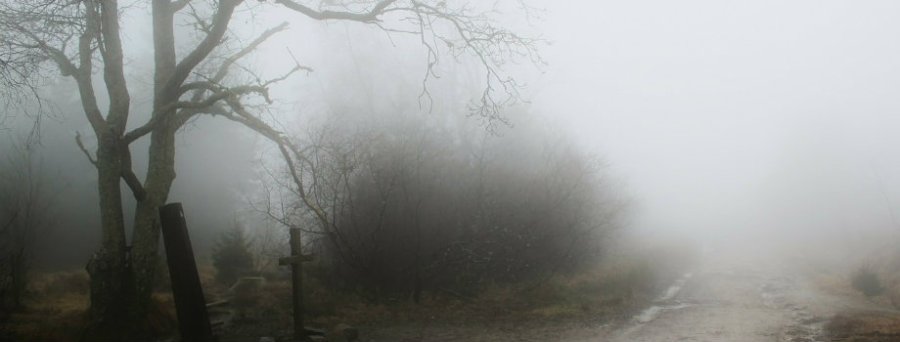
I stared out at the empty space before me with consternation. It was the first cold day of the year; fall had been slow coming, allowing the remnants of summer to coddle us all. Dusk was still about an hour out, but the chill in the air was a clear indication that the sun had tucked itself in for the night. I stood shivering with my arms interlocked across my chest and the hood of my sweater pulled over my head. Lyle was about a foot ahead of me on the path, staring straight ahead and frozen in excitement.

“This is stupid. I don’t see anything.”

“Shh!” he warned irritably.

I rolled my eyes. This wasn’t the first time I had let him talk me into some ill-advised misadventure. When he got something in his head, it was easier to give in than to argue. Two summers ago we had spent a whole night in a trailer park two towns over looking for what Lyle swore was the dashboard of a crashed UFO he had read about online. I tried to tell him that the story had likely been masterminded by a fourteen year old boy with too much tech, but Lyle was sure. We never found anything. That’s how the story always went; he had the theories, and I had the research. Twins, and counterparts. It was lunacy.

“Are we ghost hunting right now? Because I’m pretty sure you can’t see a ghost in the fog. Or, you know, ever.”

Lyle swung around and cut his eyes at me.

“Sorry,” I whispered, sardonically, in that tone every girl inherits around the age of thirteen (and treasures forever after).

Lyle positioned himself around me so that I was in front, and cupped my shoulders to force my focus straight ahead.

“You can only see it in the fog. And no, it’s not a ghost.”

I sighed, but did not let my focus waver. The last time Lyle had dragged me to a graveyard we were only kids. He had ripped off a Ouija board from the local toy store and truly believed supernatural powers could be harnessed from a piece of plastic worth $11.99. Admittedly, it scared the shit out of me when it started to move, and I had nightmares for weeks thereafter. He swears he never moved it, but I don’t know how else to explain what happened that night. Either way, I’ve mostly crossed the street at the graveyard since then.

“I hate it here,” I whispered back.

“I know. Just wait.”

So we waited. And waited. And then came the peripeteia – it appeared.

At first, it was just a shadow in the fog. Then, slowly, it materialized into the form of a woman. Stunned and silent, I tried to refocus my eyes, convinced they were fabricating images due to the long, cold, interim – but there was no mistaking those eyes. Their white glow pierced through the fog and the darkening sky; my own eyes their target. Her emergence from the fog grew steadier, and her unsettling beauty became more apparent. Her long white hair wrapped itself about her formless body, draped in a white figureless garb. Overtop, a green cloak rested upon her shoulder-less shoulders. She seemed more an apparition than a person – her floating feet did not quite meet the cold ground.

Still processing what was taking shape before me, I let out an almost muted gasp. Lyle’s grip on me tightened reassuringly, and then he stepped out from behind me, and towards her. He moved gently, with the finesse of an apparition himself. But the movement, however slight, was still enough to make the woman evaporate. As she fused into the fog again, she released a sorrowful wail, loud enough to send an otherwise unnoticed flock of perched crows back into the evening sky. The wail echoed, creating a symphony with the flapping wings and distressed squawks of the murder.

Lyle turned back to me, gleeful with his discovery.

“It’s a Banshee. She must be visiting her family.” He nodded towards the tombstones to our left.

Still numb from what I had just experienced, I followed Lyle’s gaze, before correcting him.

“No. Only her family can see her, and hear her cries.” My voice was beginning to quiver with panic. “She warns them of an impending family death.”

Lyle stared at me quizzically.

“Lyle,” I whispered, “she was visiting us.”

Shyla Fairfax-Owen ©