Statement of Sanity

It was anarchy, the way you looked at me. The twinkle behind your eyes broke all the rules, and in a heartbeat, society crumbled. We weren’t star-crossed lovers, we were aggressive defiants of the social order. And when our eyes met, cities burned. The ignition? The simple idea that what was, was not what had to be.

It was chaos, the way you ran to me. The fire behind your eyes shook the earthly foundations, and with it, structures fell. We weren’t desperate romantics, we were dedicated destroyers of the status quo. And when our minds met, truths brightened. The light? The simple idea that what was, was not what should be.

I’m writing this to let you know I’m glad we did what we did. You see, this is not a confession of love, nor of guilt; but a statement of sanity – questioned as it may be. With it, I reclaim my body; my mind; and my name.

I need you to know, I’m not sorry.

© Shyla Fairfax-Owen


Intuition

It started with nothing more than a quizzical glance from the girl next door on a stormy afternoon in September. It was the first time Jackson had seen her, and as he stared – as though marooned on a surreal planet made up of only her eyes – it occurred to him that her sudden appearance that day made perfect sense. If spring was a time of beginnings, it followed that fall would be the dawn of ends. She, he knew somehow, would be his death.

Noticing that he had mysteriously managed to grab her curiosity, if only for a second, Jackson decided to work up the confidence to approach her. He was not typically a shy guy, in fact he was usually downright impulsive, but something told him that this manoeuvre demanded a rehearsal or two. It was the way a simple glance from her seemed to tug at his brain and nestle in his gut like a parasite. She, he knew somehow, was a tumour.

Thanks to the storm, the bus was behind schedule, giving Jackson time to plan his attack. Her alarmingly green eyes, which had passed over him with an undeniable intensity, were now buried in a book. Her small umbrella seemed more protective of it than of her, and heavy droplets were rolling down her head and falling off of her pointed nose as a result. Having no umbrella of his own to offer her, Jackson opted for a more daring approach. He pulled out his phone and dialled a taxi. When it pulled up (luckily, before the bus), he gestured her towards it with a simple, “on me.”

“I’m Jackson,” he said once they were safely seated in the vehicle, which splashed silt up at the passer-bys as it took off.

She eyed him once more, squinting with persistence. Jackson almost worried that she was seeing through his veil of false-ease, but then decided to blame the dark grey day for her carefulness.

“Lianne,” she finally responded.

“Well, Lianne, where are we off to? Ladies first, of course.”

“Well, Jackson, that depends on whether you’re willing to play hookey with me.”

A subtle smirk appeared across her face just as a flash of lightening cracked through the sky. Had he not been stunned by her forwardness, Jackson might have noticed how it revealed a hint of monstrous salacity behind those increasingly haunting eyes. But wasn’t that always the story?

He, she knew somehow, would be just as easy as the rest.

©Shyla Fairfax-Owen

The End

It was unexpectedly beautiful, the end of the world.

The fires, blazing west to east. The waters flooding north to south. The earths opening up, devouring our very being. The winds scooping up whatever was left.

I watched it all in awe, and not once did I consider stopping it. There’s nothing quite like the rush of devastation. My only loss was its completion.

Welcome to HellHaven

“Welcome to HellHaven. Where innocence comes to die, and gratuitous desire comes to thrive.”

Catchy, Gina thought to herself as she watched the hostess give her rehearsed speech about the unique sexiness of an R-rated New Gothic Horror Theme Park. She still couldn’t believe she had signed up for this  gig – but she was about two steps away from desperation, and two steps past virtue. Sure, she hadn’t shelled out $20,000 dollars of art school tuition to take photos of tattooed thrill-seekers and Goth Lolitas – but maybe it would grow on her, with the right attitude. Gina sighed at the thought, and tried to tune back in to the hostess’ closing arguments. Although, it was difficult to concentrate on anything other than the getup she donned. Red fishnets, pink leather mini, breasts popping out like they were planning an escape. A little farther north her purple do sat atop her head like a beehive, and the black eye shadow and fake lashes pulled it all together. Gina wondered what she’d have to sink into to fit in.

“Ahem”

Shit. Gina had tuned out again, and it hadn’t gone unnoticed. While the other new hires had scampered off she had lingered, staring at the hostess who was now staring back.

“Gina, is it?”

“Yes, ma’am.” The “ma’am” was unintentionally tacked on to the end of her sentence like an afterthought which drained it of its respectful nature.

“Well, Gina. I see your hesitance. Resistance even. Now, if I cared I might ask you what’s on your mind and help you pro and con the scenario. But I don’t. Get to wardrobe.”

She pointed down the hall in the direction the others had left in. Ashamed, Gina nodded and launched forward, but a firm yet feminine hand on her shoulder stopped her. “And Gina?”

“Yes?”

“Smile, or growl. But don’t look indifferent. It’ll get you canned.”

By Gina’s fourth day, she had gotten just comfortable enough to not see it coming. She had succumbed to a pink pig-tailed wig and purple eye-shadow. She’d even tied up her blouse and undid the top button. But she had kept her jeans and runners – that somehow made her feel better. A quiet revolt.

It happened in the Tunnel of Horrors. She was perched between a few fake rocks that lined the blood river that “lovers” would row through in their canoes, passing bobbing heads and other appendages likely manufactured in China. Gina had propped one leg up which looked silly but gave her one hell of a shot. The objective was to get the screams of delight when the wrapped up plastic body (with a brick chained to it) unexpectedly fell into the water. The last three couples had cheered, but Gina was aching for a scream to capture. She would have stayed there all night if she had to. But, of course, she didn’t. The scream came – just not from any of the patrons.

Where the hell are they? Gina wondered impatiently as she checked her watch. The ride wasn’t on a schedule, but as one of the most popular, it usually ran twice an hour. Her body was beginning to cramp and she knew it was time to radio in a ride out, but she didn’t. That was her second mistake, the first being accepting the job at HellHaven.

When the boat finally came, Gina was so eager that she poked her head out farther than usual to catch a glimpse of who she’d be snapping. The person was alone in the boat, which was against policy. Immediately Gina grew alert. At that point, the figure was still only a shadow, but she was quite certain it was hooded. She thought to radio in for an explanation but knew it was too late. Her voice would echo and ruin the magic for this patron if it was indeed nothing to worry about.

But it was something to worry about. As his boat approached, Gina sunk back, gripping her camera, finger on the trigger. But when the body splashed down at them, the figure launched at her. He (as it turned out to be), knew exactly where she was, and had timed his own attack.

In an instance he was on top of her. Her camera dropped, crushed against the fake rocks, and finally lodged between two. Red dyed water lapped over its cracked lens as Gina fought for her life – grunting, growling, biting. The tunnel captured the sounds of her struggle, of the attacker’s laughter, and of his eerily shallow whispers: “Lets make this a real blood river, shall we?”

“Welcome to HellHaven. Where innocence comes to die, and gratuitous desire comes to thrive. Thrill seekers from far and wide travel here to lose themselves in just a few hours of monstrous glory, and it’s up to every single one of you to ensure they get every mile and penny’s worth of it. Why? You might ask. Why would people pay to experience a horror? The thing about horror is that it asks us to confront social boundaries, and to push them. Some people like to be pushed, so they come here. Others, struggle with their desire to be pushed, so they work here.”

The hostess smiled, and waited for her final statement to settle upon the crowd of new hires. A hand rose.

“Didn’t some photographer chick die working here last summer? That’s why I’m here.”

The hostess slumped, annoyance flashing behind cold eyes. “Are you a journalist? An investigator of some sort?”

The girl smirked. “No. Just a freak.”

© Shyla Fairfax-Owen


The Telluric Goodbye

I looked up at Fern, her eyes skimming over the top of my head as her thoughts travelled far away from our now. She was a Telluric; part of the last scoop during the salvage. She had grown up among Astrals and sometimes it was easy to forget that she was from Earth – a different breed altogether – but in these distant moments, it was apparent. In these moments, the ones in which she could be both present and not, I was utterly bewildered by her difference. Part of me knew I only loved her because my curiosity overpowered me. But most of me didn’t care why I loved her, just that I did.

She shivered lightly. Her hair growth was selective, red, sprouting mainly from her head and above her eyes. Some growth occurred under her arms (of which she only had two) and a thin layer covered the rest of her. It gave her a smooth texture that I could only feel in the palms of my four hands. It meant she was often cold, but the adaptation meant it was tolerable. Some of the Astrals had advocated for more salvages overtime when we’d discovered there had still been some scattered survivors on Earth, but they had spent too much time in their natural habitat. They’d freeze to death, we were told.

I think it bothered Fern sometimes, to know there were others stranded down there. She had volunteered for a number of anatomy studies hoping to find a viable solution; some way that Telluric genes could be manipulated once matured. None of it was very promising; but she kept going back to the labs, hoping for different results. That was the definition of insanity. She hated when I’d tell her that, so eventually I stopped, and just let her go on being insane.

“Stop looking at me like that,” she whispered a hint of a smile in her tone.

I shied away, fixing my eyes anywhere else. She sunk her shoulders down and nestled herself under one of my arms so that her head was resting on my chest. She nuzzled her nose into me, burying her face in my fur. I wrapped two more arms around her, offering warmth, and leaned back on my fourth. We gazed out at the vastness before us. It was nice.

The next day when she stepped into the lab with that hopeful grin of hers, I returned it. I had decided to stay in the waiting room this time, even when she insisted I go home. For no particular reason, I wanted to be there with her.

“She’s prone to her Telluric instincts. She has no memories of Earth, but her genetic makeup seems to. It’s fascinating, really.”

I flashed cold eyes at the doctor keeping me company, afraid he was preparing me for news I wouldn’t want to hear. The apologetic eyes he returned told me it was true.

“You’re sending them back?” I asked. The scent of my fear wafted over us.

“Edoc, you knew this was always the plan.”

I winced, as if the truth had a vulgarity to it.

“I didn’t think it would be her.”

“Of course you did.”

“When will you tell her?”

“Edoc, she volunteered; like she always does. She asked me to tell you.”

“Why?” I looked towards the closed off room that she lie behind, being poked and prodded.

“Tellurics hate delivering sad news. I suppose she figured this would be easier.”

“But I won’t be able to share my sadness with her.” My fur rose, searching for the being connected to its emotions.

“I suppose she prefers it that way.”

“No. She likes it when I share.”

“She wants to see Earth,” the doctor continued, ignoring my reaching fur. “You can’t blame her; it’s a deep-seeded instinct. She tried to have us remove it but we couldn’t.”

My fur pulled me up and dragged me to the door, although I did little to fight it. Inside, a shocking scene unfolded before me.

There she was, teary-eyed and quivering lips. Her body vibrating with a combination of nerves and excitement as they bolted her into the launch pod. She caught my eyes, and quickly shut her own. Her long stringy head hairs had been braided behind her to keep them in place when the pod shot her away from me.

I looked at her through the glass, and suddenly, that difference of hers was altogether distasteful. An Astral would never abandon its partner, without so much as a simple sharing. An Astral would never lie about its intentions, or keep secrets. An Astral would never leave home to live among ruins and strangers.

And then it was there, loud and clear – this wasn’t her home. That’s what she had been trying to tell me in all of those present yet not moments. This wasn’t her home.

©Shyla Fairfax-Owen

Remember

Zenith squeezed her eyelids together, shutting out the night, and tried to remember what it was like. Home – as arbitrary a word as any other, and yet it carried with it a heavy weight that could not be denied.

“I don’t think I can see it,” she admitted in defeat. They’d been at it for hours with no improvement.

“Sure you can. Breathe from your centre, and connect to the memory. It’s there, Zenith. You know it it.” Dr. Lux’s urging was as gentle as she could manage in her frustration.

Zenith sighed, and tried to release herself of the sensation that she was only a test subject.

Since humankind migrated to this planet some 400 years ago, Optical Memory had been their most cherished sense. It was the ability to see this new world through Earthy eyes; historical perception – a collective memory passed down from generation to generation so that the legacy of their diaspora would always be a part of them. But now, that was all changing.

With each passing generation it seemed Earth fell further away as Zenith’s people thrived, adapting to the host environment to a point of (accidental) pure assimilation. Soon enough, the optical memories began to fade as trees melted and oceans evaporated to reveal rocks – a plethora of colours and shapes humankind had once not even known. This new world was becoming the familiar, the recollection of Earth for comfort becoming less necessary. Less thought of. Zenith, the elders feared, might very well be the last to see it. That is, if she could any more.

It was a few days before she told anyone that she had seen her last cloud. Clouds, she was realizing, was just another false perception; a deception of her genetically human eyes. Slowly but surely, her world was changing before her until she didn’t even recognize it any longer. Strangely though, something about the change felt right. Losing the memories felt less like loss to her than to the elders, who had lost them long ago. Zenith’s inability to hold on for them, it seemed, marked Earth’s final death. She and the few others had been undergoing tests and observation ever since. It was an arduous advent, and she just wanted it to be over.

“I just see the rocks. I’m sorry.” Zenith averted her eyes, hating having to let down not only Dr. Lux, but her entire race.

Dr. Lux forced a smile and shrugged; “Get some sleep. Come back fresh tomorrow.”

That night Zenith couldn’t get a wink of sleep. Something about the way she had left things stuck with her like a deep itch she couldn’t quite reach. “I just see the rocks.” Why had she said it like that? The rocks were the most beautiful, welcoming, visions Zenith had ever known. The rocks were Home.

“Feeling better today, Zenith?”

“No.” Zenith looked at Dr. Lux, determined to assert herself. “Why are we doing this?” she asked firmly.

Dr. Lux looked stunned, her face hardened, then softened again.

“You know why we’re doing this Zenith,” she said in that lulling tone of hers. “You and your peers are the guardians of humanity’s collective memory. It’s so important that we remember.”

“Why?” Zenith asked without skipping a beat, or breaking her glare.

Dr. Lux rose from her chair and swept across the room to the window facing Zenith. She stared out of it for a long, silent, time. Without looking back, she finally spoke. “Because if we don’t remember our mistakes, we’re inclined to make them again. It’s a genetic fault that can only be controlled, not fixed. We can’t let ourselves destroy another great planet. We have to know that Earth was once strong and beautiful, and ours. We have to remember. We just do.”

Zenith shrunk. It’s not that the response was entirely satisfying, but rather that it couldn’t be argued. The history of humanity on Earth had been irreparably stained. It was a part of them, of her. No matter how badly Zenith wanted to move forward, Earth was her ancestry – how could justify not looking back?

“I know it’s over, Zenith.” Dr. Lux broke Zenith from her contemplation. “You can’t see it because you can’t feel it. The whole premise of Optical Memory is that it’s collective and hereditary. Things like that only exist as long as the genetics deem them necessary. We’ve all moved on, against our wills, I suppose.”

Zenith thought Dr. Lux might be whimpering, but she still hadn’t turned to face her.

“Go home, Zenith. We’re done.”

The statement was loaded, and stung. Zenith obliged, lugging her body so heavy with confusion, out the door.

©Shyla Fairfax-Owen

Read more from this universe in Perception

Birds Are So Obnoxious

Birds are so obnoxious. It’s always my first thought in the morning. Not the damp mouldy air that settles in my cot; not the slop I will be served for breakfast; not the painful loneliness that reaches depths of me I once didn’t know existed – just the birds.

The window – barred, of course – is high above my head, leaving me with the impression that even the squawking nuisances are looking down on me. They certainly have more freedom. Maybe that’s why I hate them.

The door knocks an entrance warning and I pull myself upright, hardly surprised anymore at the weight of the chains. He enters and wordlessly hands me a bowl of pale sludge. I imagine pulling a knife from behind my back and planting it in his forehead, but I have no knife. Knives may no longer exist for me outside of my fantasies. The world itself may not exist for me outside of my fantasies – except for those damned birds.

I glare at my captor. It’s been a long time since I’ve asked questions, tried to reason, or begged for mercy. Acceptance? Not quite. Exhaustion. Yes; that seems more accurate. Go figure, it’s the end of my world and all I want anymore is to sleep in, one morning, and not hear those fucking birds.

Shyla Fairfax-Owen ©

V Positive

The sun dominated the sky that day. Clouds cowered under its gleaming oppression. Even the birds seemed to fly low. Derek squinted, knowing immediately that he should have stayed home. And he should have. That was the day Derek’s life fell to shit.

He fought the heavy doors of the testing facility open. Their weight surprised him as much as his own weakness did. He told himself it was just early and he was tired, but honestly, lying to himself was getting old. There was nothing salubrious about it.

Inside, Derek was greeted by an older woman dressed in disdain. It was obvious that she hated being there, which struck Derek as odd considering most such facilities ran on volunteers. He’d never been in one, but many anecdotes attested that volunteers were generally people who had lost someone to the merciless disease. People whose grief drove them. Derek supposed it was likely that one day, the grievers might wake up to realize their services hadn’t done a thing to change circumstances. In fact, the numbers grew each week. That could make a person grow bitter – like the woman leading him down the hall.

“You’re running on borrowed time, Mr. Alvarez,” she announced with a tone that denoted lack of surprise.

Positive. He thought the word, but could not get his tongue to pronounce it.

“Positive,” she said for him, avoiding eye contact as she skimmed the test results. “And the gene,” she added without emphasis. Derek could have sworn he saw her shoulders drop an inch or two, though.

Derek watched her silently, choking back anger or hysteric sadness, whichever was threatening to push to the forefront. The bitter lady was now visibly smothering her tired loathing and reaching deep down for something that might mimic patience.

“The gene, as you must know, is a birth defect.” Spiel time. Standard, he imagined. “About 40% of people are born with it these days, and it lies dormant until it comes in contact with the virus. Now that that’s happened, you are V-Positive, and the gene will begin to mutate.”

She handed him two bottles of pills, placing the first in his left hand and the second in his right. Pointing, she continued.

“These ones will suppress the symptoms, and these will slow the change.”

Slow. Not stop. Derek winced. The med-cocktail would only slow the inevitable. Sooner or later, he was going to turn into a monster.

“The virus can be transmitted through any bodily fluid. We ask that you respect the right of others to not be infected by malicious intent.”

She looked away again – seemed to drift off to a place only she could see. When she returned mere seconds later, her eyes had softened.

“Even with the medication, certain circumstances can cause a flare up of symptoms. Among them is increased heart rate and body temperature. The sun and sexual activity are the two leading causes of outbreak. You’d do best to avoid these.”

She reached into her pocket and drew a small syringe, thick enough to insert the microchip.

Without warning she stuck the tip in Derek’s arm and injected.

“This chip will measure body temperature and other symptom levels. It also has GPS tracking. We will receive urgent notification the moment you become at risk.”

“And then what?” It was the only question Derek asked that day, but he already knew the answer.

She sighed and then looked him square in the eyes. Without quiver or hesitation, she said, “And then we put you down.”

Derek held her stare, and as he did so, his heart rate increased.

Devoured

“Please don’t make me,” Alice murmured.

Her brother, Eric, shot her a look and pushed the plate of food nearer to her face. The salt-water fumes charged through her nasal cavity and landed in the pit of her empty stomach. It lurched forward, but came to a prompt stop when it realized it had nothing to give.

She hated fish; she hated seaweed; she hated not knowing where she would ever find a decent meal, again. She did not, however, hate Eric’s ambition. Since they’d been on their own he had provided well above her expectations.

“What is it?” she asked hesitantly.

“I’m sure you don’t want to know.”

That was true. Whatever it was it would sustain her, but for how long? How long were they meant to live this way?

Pushing the dreary thought from her mind, she closed her eyes; took a deep breath; and scooped the mystery flesh into her mouth – gills and all.

Four years later, the world was still broken, but Alice was fierce and strong. She and Eric had become quite the team, only occasionally having brief encounters with other survivors. Mostly they’d make some trades and move on. Groups were not their thing. Eric had become quite the fisherman – and Alice quite the fish eater. Something about the meat fueled her. She was sixteen now and despite the elemental exposure, hard labor, and lack of rest, she had grown into a stunning young woman. She was tall; lean yet muscular, with eyes of emerald and caramel skin that seemed to glow in the sunlight. She looked remarkably healthy, and it was not lost on her that the men they would come across could not help but gawk. She was never in danger though, and seemed to wield a certain power.

It was the mermaid meat. She knew that, now. She gobbled it up happily every night. It seemed there was enough to last a lifetime – or several. It would have to. Consuming the mermaid’s flesh had given Alice eternal life, and eternal wealth. In these times, that just meant she would never starve, again.

Alice was pleased with her vigor, but it panged her to see Eric suffering, so. The mermaid could only be consumed by one; could only offer its powers to one. Eric had given it to his weak younger sister that day on the beach, and was paying the price with each passing month.

Often, Alice thought about what capturing the mermaid must have been like. She envisioned her brother, mighty and heroic, slaying the creature. In her fantasies, it was like a fairytale. But she knew in actuality, it would not have been so magical. It would have been violent, bloody, and monstrous.

The first time she saw a mermaid was the day before the war. It had washed up on the shore near their house, and Alice had been the first to spot it. The creature had a fish tail below, and smooth creamy skin up top – her breasts bared shamelessly. Her eyes were red and dug into Alice’s soul as she writhed and hissed. She even had horns, just like Alice was told she would. She was an omen, just as Alice had read about.

And now that she had consumed her (or one of her kind), Alice herself was the Omen. It would only be a matter of time.

Just before her eighteenth birthday, Eric drifted off to the next world. She committed his body to the sea, whispered well-wishes to his soul, and thanked the heavens that he would not suffer through her transformation. She could already sense it beginning, and she was ashamed of how good it felt.

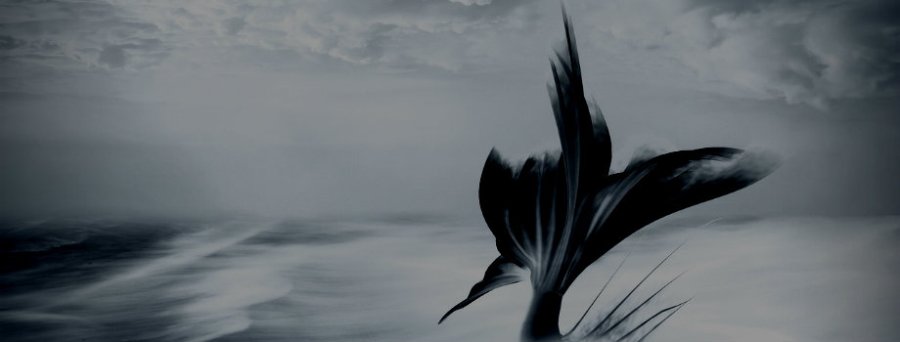
The air became thick and clogged her airwaves, filling Alice with a thirst that even six years of destitution had never brought on so strongly. Naked, she crawled towards the sea, carried by her throbbing desire to splash about in its coolness. She huffed and puffed until she finally got far enough out to sink into its abyss. Below the surface her legs stiffened and coalesced until she had only one. A stinging sensation over came them as scales fought their way out of the skin that was simultaneously greening in color. The mass that had become her lower body grew a fin and flailed about, thrashing her body with it. A school of fish tried to scoot by, but Alice caught their scent. She could feel her jaw rip open, tearing at the hinges until her mouth hung low and wide. Instinctively, her body lunged towards the fish and she scooped them into her maw, devouring every last one. Her teeth, small but sharp, shredding apart the contents of her meal quickly and effectively.

She looked around; her body and mind screaming for more. She swam deeper and deeper, following a new monstrous intuition deep inside of her. The scent was staggering, and made her tingle from nose to fin. At the bottom of the sea she found it – a man, strung down with rope and a rock in his lap. He looked familiar, but mostly; he looked nectarous.