Top 15s: 15 Highlights From the Comics You Won’t See in Logan

With all the buzz, excitement, and acclaim for the latest Logan movie, it’s difficult not to think about it in conjunction with the many comics upon which it is based. Although the premise of the film is heavily inspired by the alternative universe Wolverine comic book series, Old Man Logan, it is also entirely tied into the universe of the X23 comic books series. What’s so interesting about the conflation of these two books, is how much creative storytelling it required, since these two stories are not at all connected and do not even take place within the same universe.

It was clear right from the beginning that the movie couldn’t be very closely linked to Old Man Logan because of the book’s reliance on Avengers characters. Instead, the movie simply borrowed the gritty realism of prominent themes such as regret, family, aging, and mortality. This was all applied to an X23 storyline, that would essentially facilitate the passing of the torch from Logan to Laura (which is, in fact, something that eventually happens in the X-Men comics).

Despite the many differences, it seems unfair to compare the movie to the books. However dissimilar, Logan offers a really powerful way to end Wolverine’s chapter. The film manages to capture the humanity of Logan and Charles by addressing the one thing that affects all of us – death. So, rather than compare, contrast, and pass judgment, I just want to visit the highlights of the great stories the filmmakers were able to draw upon.

View List (beware of spoilers)

Image via: Screenrant


Top 15s: 15 of the Most Controversial Moments in Buffy the Vampire Slayer

Today marks the 20th anniversary of Buffy the Vampire Slayer! In celebration, here’s a look back on some of the craziest stuff the series had to offer.

During its seven-season run (1997-2004), Buffy the Vampire Slayer was constantly pushing the envelope. Network politics be damned, creator Joss Whedon was not above shaking things up: “Censors. Don’t love ’em.” Seasons one through five originally ran on the WB, during which time there were a lot of restrictions by which to abide. However, a show that worked primarily on the level of metaphor was able to get around a lot of things and have fun doing it. Those first seasons still got to deal with issues related to dating, parents, and abuse. Things became a little touch and go in 2000 when the series began to develop a lesbian relationship. Whedon admits some things had to be cut and kissing was not allowed, but he was dead-set on moving forward with the story-arc anyways. For seasons six and seven the series moved to UPN, where Whedon was essentially given carte-blanche. It comes as no surprise then that these seasons dealt with a even darker subject matter. Not to mention a number of heated sex scenes; even Willow and Tara got to spice things up.

Ultimately, Whedon’s desire not to shy away from controversy made for seven years’ worth of compelling TV. Buffy the Vampire Slayer entertained, enthralled, and taught us a lot about life. Today, network TV is littered with sex, drugs, and violence and viewers gobble it up. But it’s important to reflect on the history of TV censorship and progression and to pay tribute to the predecessors, like Buffy, that set the stage for anything to happen next.

View List

Also check out, 15 Reasons to Re-Watch Buffy the Vampire Slayer

Image via: Coffee and a Blank Page

Top 15s: 15 Reasons You Need To Re-Watch Buffy The Vampire Slayer

March 10th of this year will mark the 20th anniversary of the premiere of Joss Whedon’s beloved classic TV show, Buffy the Vampire Slayer (BTVS). That may come as a shock seeing as BTVS seems to have a sense of timelessness that makes it easy to forget how old it really is – especially since Buffy fandom (and, by extension, Whedon-fandom) is still so prominent in pop culture. Today, if you are looking for a quick Buffy fix you can hit up Netflix to revisit some of your favourite episodes; check out a number of Buffy podcasts; pick up a number of Buffy (or Angel or Spike) comic books; or just dive into some dense Buffy philosophy via the many theoretical and academic writings on the topic.

However, if you’re not a Buffy super-fan but vaguely recall seeing some episodes and noticing Sarah Michelle Gellar on all of the magazine covers of the 1990s, you might be thinking – what’s all the fuss? The fuss is that BTVS had a major hand in changing the nature of TV storytelling and in bridging the gap between academia and pop culture. The series is entirely about subverting viewer expectations and is as smart as it is fun. If you don’t quite get it, it probably means it’s time to re-watch it. Here are 15 reasons why, as an adult, you will not regret giving it another go – once more with feeling.

View List

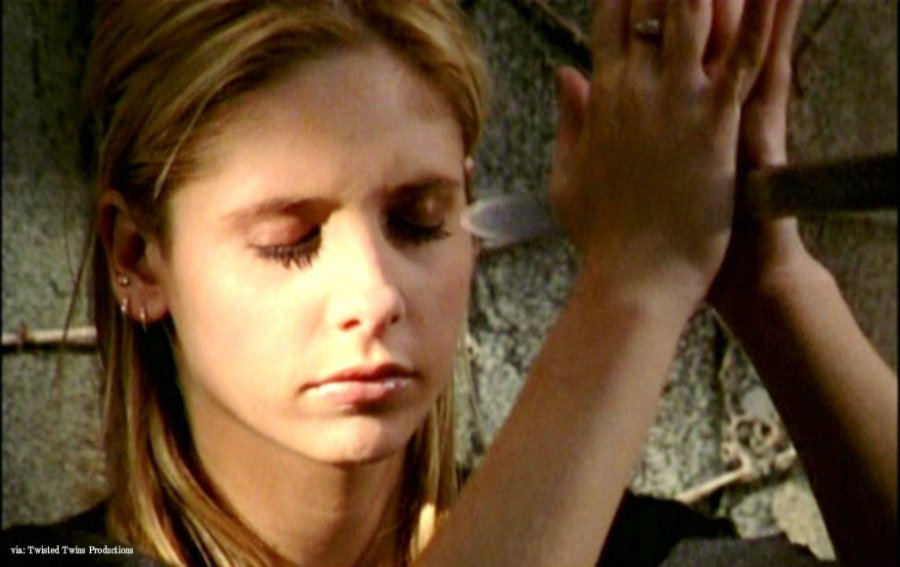
Image via: Twisted Twins Productions


Top 15s: 15 Gruesome Villains We Love to Hate

For generations, classic storytelling has used the convention of the gruesome villain to incite the excitement and anticipation that comes with following the protagonist into the grips of danger. While not exclusive to the horror genre, it plays to the cathartic and escapist nature of the scary or thrilling narrative. The villain can work on various levels: juxtaposing the hero to create a clear distinction of good and evil, mirroring the hero to blur the lines between right and wrong, cautioning against giving into the darker aspects of human nature, and reflecting that which we might fear about human nature and ourselves.

Film theorist Robin Wood explains that the monsters we create for our stories are really just manifestations of that which we have repressed most in our civilized society – people who look different, or act different, or who can otherwise be considered outside of the norm. It’s fair to say then that the monster represents our own fears of being out-casted. However, it is also fair to say that in this golden age of violent narratives, the monster is not just to be feared, it is to be admired. There is something utterly captivating about a charismatic villain. They can make our skin crawl, shock us, scare us; and yet, we can’t seem to look away. Here are 15 gruesome villains of which we just can’t get enough.

View List

image via: Screencrush

Beyond the Threshold is EXPANDING

Hi all!

This is just a quick update about what I’ve been up to, and some changes you will notice on Beyond the Threshold. As much as I love writing flash fiction, there is so much more within the realm of speculative fiction that I want to explore. As you may have guessed, I’ve always been a lover of books, comics, TV and movies. I spent 7 years in post-secondary education for film studies, so when it comes to discussing film and TV, I really can’t shut up. So I’m expanding Beyond the Threshold to leave room for things such as more book/comic reviews, and Top Lists for a variety of topics regarding TV and movies. I’m currently writing for a pop culture website, so a lot of this content will be linked to those published articles. And, of course, I will also continue to post my own fiction here too.

Thanks for all the support – I hope you’ll enjoy the expansion. Stay Strange!